

Some Thoughts on the New Dietary Guidelines
The US Department of Health and Human Services and the US Department of Agriculture (USDA) recently released the new dietary guidelines for 2025-2030. Like so many government guidelines, there seems to be some good updates and some not so good. This mixed bag of good/bad relates to the relationship between the food industry with one set of goals and the USDA with another.
In the past the food industry lobbied heavily and often successfully for policies that favor foods that may not be so healthy but have high demand and sales. This is where the new guidelines have a good point. They call for the elimination of ultra-processed foods (UPFs). Past guidelines have meekly suggested reducing UPFs, but no more. These are foods that are typically:
- Highly processed to improve shelf life.
- Devoid of adequate fiber
- Devoid of adequate essential nutrients.
A prime example is refined (white) flour. Whole wheat contains important amounts of our twenty-three essential nutrients. The term “essential” means that we need these for specific body functions, functions that can lead to disease if they do not work. A ½ cup of whole wheat contains twenty of the twenty-three essential nutrients and these are contained in the germ or center area of the kernel.
Regrettably, the kernel also is home to the essential fatty acids. Regrettable, because fatty acids can go rancid or spoiled with time. When the flour is milled, the primary goal is to remove the germ and its fatty acids to improve shelf life, but it also removes most of the twenty essential nutrients that also live in the germ.
Refining compounds the nutritional value by also removing 80% of then healthy fiber. The fiber is almost entirely in the bran. To get to the germ most of the bran/fiber is removed during milling.
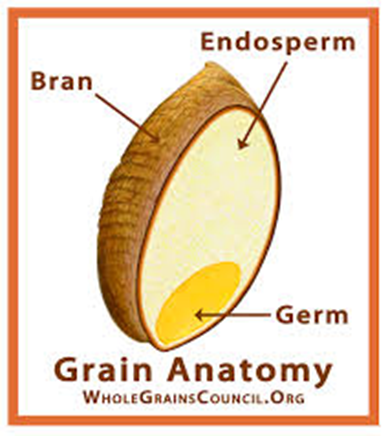
The contents of the endosperm, carbohydrates and protein make up most of refined flour.
Interestingly in the 1960’s and 1970’s, wheat germ removed during milling of white flour was sold as a “health food” because of the elevated levels of micronutrients. While white flour was taking over, the hippies were eating wheat germ trying to stay healthy!
The next bait and switch of UPFs such as white flour was to give it a name change to “enriched wheat flour.” Unfortunately, while the twenty essential nutrients were removed by between 60-100%, enrichment only required five to be replaced to some degree. If that is a good bargain, I will buy a new BMW, remove twenty parts like the hood, back seat, cruise control, etc. and put five back to sell you an “enriched” new car!
Refined wheat is just an example of an UPF ingredient, but it demonstrates their nutritional inferiority. They have higher shelf-life and therefore are cheaper, but they are nutritionally devoid at important health expense. One of the best examples of the health expense may be the increasing rates of colorectal cancer in younger adults. A study of 29,105 female nurses younger than 50 years who underwent screening, found those with the highest consumption of UPFs had a striking 45% increased risk of colorectal cancer. (1)
The suspected player in that risk is the exceptionally low fiber content in UPFs. Fiber helps to feed a healthy microbiome which produces anti-inflammatory molecules such as butyrate, acetate, and propionate. Inflammation is a potent driver of cancerous cell transformation. There is some concern that the additives such as dyes in UPFs may also contribute, most of which are approved in the U.S. but banned in Europe as carcinogens!
Based on the first ever call to remove UPFs rather than the faint past calls to reduce them,
this is an A+ to the new food guidelines and pyramid. The changes that make it a mixed bag are placing meat protein and dairy at the top suggesting that it should be the biggest part of the diet by volume.
Those protein sources can be important, but placing them ahead of fruits, nuts and true whole grains is out of balance. Fruits, nuts, and true whole grains are potent sources of nutrients, heathy fatty acids, fiber, and phytonutrients which have been shown to be some of the most important food components
Placing meats at the top of the new guidelines is problematic without clarity about what type. Higher amounts of red meat or processed meats has been shown to increase colorectal cancer risk in several studies. (2) The lack of cautioning about the importance of other protein sources such as white meat/poultry and fish is an important omission.
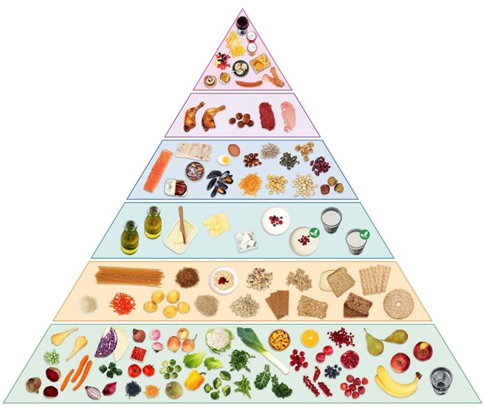
Perhaps the best rendition of healthy new guidelines is that from Sweden. They place vegetables and fruits as the largest volume of the diet. Whole grains, nuts, healthy fats are next followed by the animal protein sources. This guideline touches all of the knowledge base about healthy diet and does not get watered down by industry pressures.
So where do I stand with these new guidelines? They are about like one semester I had in undergraduate college – an “A”, several “Bs” and a -C. Truly a mixed bag!
- Wang et al. Ultraprocessed Food Consumption and Risk of Early-Onset Colorectal Cancer Precursors Among Women. JAMA Oncology, 2026;12;(1):49-57.
- Zouiouich et al Meat Consumption in Relation to Colorectal Cancer Incidence in Anatomical Subsites in the National Institutes of Health-AARP Diet and Health Study. Current Developments in Nutrition, 2025;9(9):107540.
