

Ultra-processed Foods, Emulsifiers and Our Ill Health
There has been a wealth of discussion within the health care community about the adverse effects of ultra-processed foods (UPFs). Recent studies have shown the link between higher consumption of UPFs to some of the most prevalent health problems such as obesity and diabetes.
It seems that these foods are “engineered” to allow their consumption faster than unprocessed foods as they require less chewing. This diminishes the signaling to the hypothalamus, the brain area which triggers satiety or the signal of fullness which tells us to stop eating. A recent study had patients eat an ad libitum or “what you feel like” whole food diet for 14 days and then an ad libitum high UPFs diet for 14 days.(1)

While on the UPFs diet, subjects consumed 500 more calories/day compared to when on the whole food diet. This is an approximate 30% increase in caloric energy consumption due to the reduced signaling of “enough”.
The result of the caloric intake on the UPFs diet, subjects gained 1 kg in just 14 days. Imagine the effect of this diet for a whole year. In contrast during the 14 days on the whole food diet resulted in the exact opposite, a 1 kg loss.
The negative effects of an UPFs diet is not limited to weight gain and the associated disease risks. these foods also have been found to have strong negative effects on gut health. One of the other traits of an UPF diet is that they contain high amounts of emulsifiers. These are added to a “manufactured” food the help ingredients that don’t mix well together do so. An example is trying to mix olive oil with water. In whole form, they do not mix but when an emulsifier is added they do. UPFs mix several things together that do not mix well – unless an emulsifier is added.
So, what is the problem with emulsifiers? There is a protective layer of mucin that helps separate the bacteria in the gut and an inflammatory inducing endotoxin they produce called a lipopolysaccharide (LPS) from the lining tissue itself.
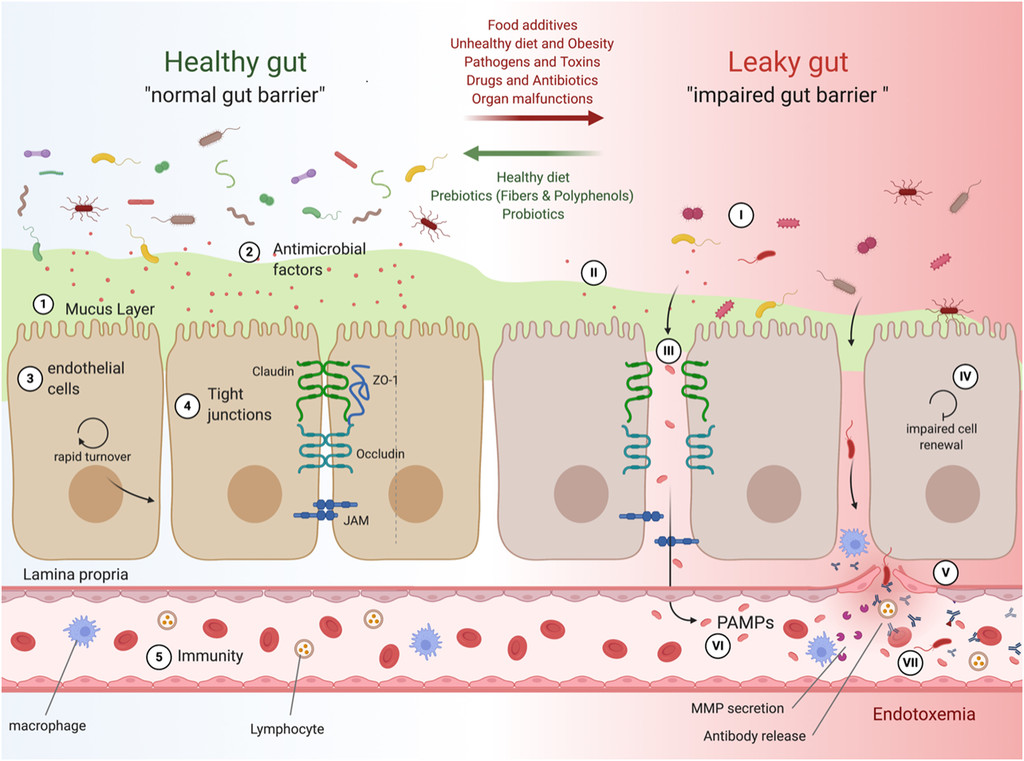
In the image above, the mucin is the green layer on the top of the cells protecting them from the bacteria and endotoxins. The right side of the image shows erosion of the mucin leaving the cells open for damage.
In inflammatory intestinal disease such as Crohn’s disease, the gut barrier has areas of damage to the epithelial cell that line the intestine. Erosion of the protective mucin is a known mechanism. In a trial with subjects with active Crohn’s disease, the role of dietary emulsifiers was investigated.(2) Subjects with active disease were randomized to a emulsifier free diet or a standard diet including emulsifiers.
Forty-nine of those on the emulsifier free diet reached desired symptom reduction compared to 31% in the control group. Crohn’s disease is one of periods of remission which accounts for the 31% of controls reaching that point. A major objective in Crohn’s disease is a lasting remission over time. Those on the emulsifier free diet sustained remission out 2 years compared to the controls.
Crohn’s is not the only disease thought to be related to emulsifier intake. Irritable bowel syndrome (IBS) which is very common has also been associated with these additives(3). The gut barrier also contains 75% of our immune activating tissue and irritation there will aggravate any systemic problems related to inflammation.
There are many emulsifiers used in UPFs. The 3 most common are carrageenan, polysorbate-90 and carboxymethycellulse (CMC). Others may include lecitin, methycellulose and polyethelene glycole (PEG). Generally, when you read ingredients in the food label, if you don’t recognize it as a food, it is likely an emulsifier or artificial coloring.
When a drive through the Eastern Shore with all the expansive farmland only to round a curve a see a giant food manufacturing plant, I am reminded of a truism – food is grown or raised, not manufactured!
Rinninellaet al. Food Additives, Gut Microbiota, and Irritable Bowel Syndrome: A Hidden Track. Int J Environ Res Public Health, 2020;17(23):8816.
Hall et al. Ultra-Processed Diets Cause Excess Calorie Intake and Weight Gain: An Inpatient Randomized Controlled Trial of Ad Libitum Food Intake. Cell Metabolism, 2019;30(1):67-77.
Bancil et al. DOP097 Emulsifier restriction is an effective therapy for active Crohn’s disease: the ADDapt trial – a multi-centre, randomised, double-blind, placebo-controlled, re-supplementation trial in 154 patients. Journal of Crohn’s and Colitis, 2025;19, Supplement_1: i262.
